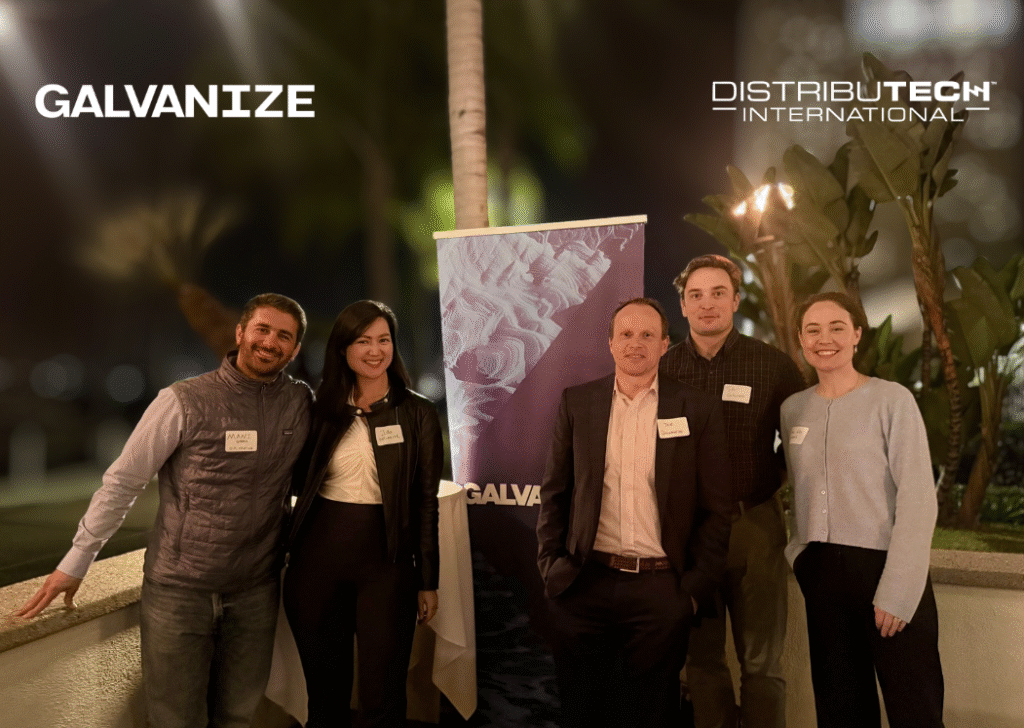
Last week, members of the Galvanize team were on the ground at DistribuTECH, where we hosted a dinner alongside leaders from across the utility and energy ecosystem.
At the dinner, Annie Hills, Ida Hempel, Joe Stekli, Mani Ghiasi, and Tyler Rudolph shared Galvanize’s perspective on investing at the intersection of energy innovation, resilience, and intelligence—and why connecting these forces across markets drives conviction in where value is being created across the energy transition.
We were fortunate to be joined by senior leaders from Southern Company, NextEra, National Grid, Constellation, SDG&E, Duquesne Light and Southern California Edison, as well as Galvanize portfolio companies Octopus Energy and GE Vernova. The conversations reinforced how rapidly the operating context for utilities is changing, and where focus is converging.
Three takeaways from DistribuTECH:
- Load growth is now a structural feature of the system.
Rising electricity demand is no longer a transient or single-driver phenomenon. AI is accelerating the trend, but broader electrification and industrial growth mean utilities are planning for sustained, long-term load growth. This shift is fundamentally reshaping planning, investment, and system priorities. - Speed is the binding constraint.
The system’s core challenge is not a lack of generation technologies, but the pace at which capacity can be deployed and integrated. Interconnection backlogs, aging infrastructure, and coordination challenges are now the dominant bottlenecks. This elevates the importance of solutions that reduce time-to-power and unlock existing capacity. - Utilities have moved from exploration to execution.
Across the conference, it was clear that utilities are past the “why” of decarbonization and grid resilience. The focus has shifted decisively to execution at scale within real-world regulatory, operational, and reliability constraints.
We left DistribuTECH encouraged by how closely these conversations align with Galvanize’s long-standing focus, and confident in the role we can play as the system moves into its next phase of execution.